
A String to Uppercase Converter is a specialised web tool that converts any text given into its uppercase format. This technique includes transforming all lowercase alphabetic characters (a-z) in a text string to their uppercase counterparts (A-Z), while leaving digits, symbols, and already uppercase letters as they are. It is an important tool for data formatting, programming, content creation and uniformity of digital documents. That’s where our free, browser-based converter comes in handy. It’s a quick, accurate and easy way to solve this common text manipulation problem without having to resort to manual editing or complex tools.
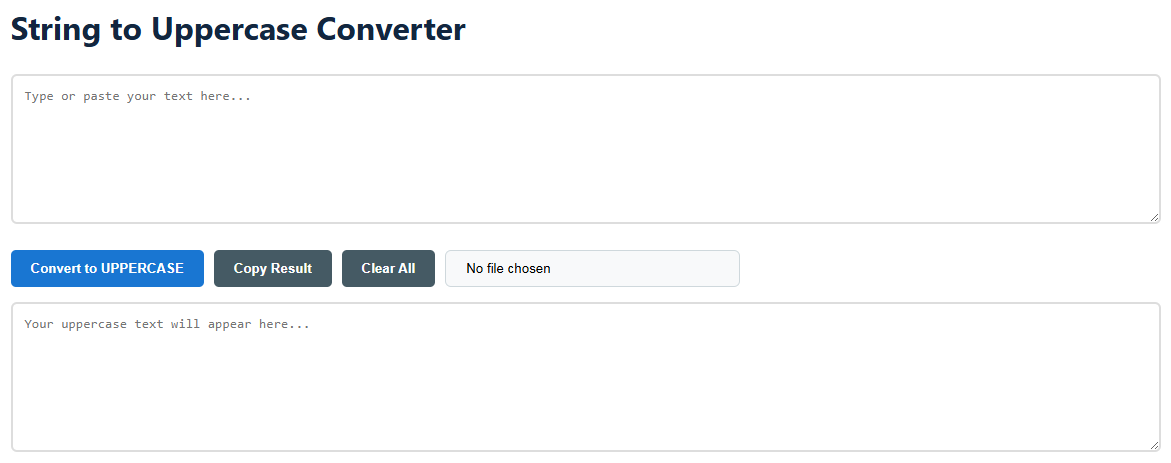
Our tool is easy to use; no technical skills are necessary. Follow these simple step-by-step instructions to change your text quickly. The UI is designed for optimum usability so you can focus on your content, not the process. Whether you are converting one sentence or an entire document, the conversion happens in seconds. Here are the complete instructions to make the most of this sophisticated formatting software.
If you are dealing with more than one piece of text, for best results, paste everything into the text box at once. The converter will do it all in one go. Then you may copy the full uppercase output without having to convert over and over again, reducing the chance for errors.
There are many practical uses of converting text to uppercase in many fields. This simple alteration is more powerful than it looks, from increasing visual communication to addressing specific technological requirements. With familiarity of such applications, you'll use the tool better for your own tasks, be they work-related, academic or personal. Here are some of the most prevalent and impactful cases where an uppercase converter is a must-have.
This tool is easy to use, but the method behind it is based on several well-known concepts in computer science and character encoding. This section describes how the conversion works from a technical point of view. This gives insight into the reliability and correctness of the results. This foundation can be particularly helpful for developers and technically-minded users wanting to implement similar capabilities into their own programs or scripts.
The conversion mechanism is based on predetermined character mapping established by the Unicode standard and the ASCII codes. Each lowercase letter (e.g., ' a ') has a particular numeric code point. The tool knows these code points and transfers them to the code point for the uppercase letter (e.g., 'A'). This mapping is language-aware and consistent for the Latin alphabet, providing proper conversion across languages and locales.
Yes, our converter supports a broad range of characters from languages written in the Latin alphabet. It appropriately transliterates characters with diacritical markings (é to É, ä to Ä, ñ to Ñ). This application is based on modern JavaScript methods, respecting internationalisation standards and therefore suited for multilingual writing.
Numbers (0-9), punctuation marks (., !, ?), maths signs (+, =, %) and other special characters are left totally untouched. The conversion algorithm is meant to work solely on alphabetic characters. Spaces, tabs and line breaks are retained so that your text is still in the same structure and layout as the original.
Opting for a specialist online text case conversion tool brings benefits compared to doing it manually or using built-in program capabilities. These benefits result in real gains in efficiency, accuracy and workflow. Using a particular utility, you save mental energy and effort on the information itself, not on the formatting. So, here are the major perks that make this tool a good addition to your digital toolkit.
We’ve answered the most common questions consumers have about String to Uppercase Converter. This FAQ section is meant to give you quick answers and clear away any questions you may have about how the tool works, its limitations and recommended practices. If you can't find the answer to your query here, feel free to contact our support team for any more assistance.
There is no set limit; however, your device's RAM and browser performance will be a factor in how much you can load. It can easily process documents of several hundred thousand characters. For very large files (like whole novels), we propose performing the text analysis in smaller chunks to keep the browser responsive.
This particular utility is just dedicated to converting text to uppercase. We have tools on our website for this, to convert to lowercase or to title case (capitalising the first letter of each word). You may find links to these similar utilities in our tools navigation menu.
Sure. The converter is designed to be responsive so that fit on all screen sizes. It works great on smartphones, tablets, laptops and desktop computers. All features, including file upload, conversion and copy, are supported on touch screen devices.
The program currently supports plain text files (.txt), comma-separated values files (.csv) and JavaScript Object Notation (.json) files. When you upload a file for conversion, the tool retrieves the text content. Complex formatting (from word processing programs, .docx, etc.) will not be kept. For these, we suggest copying and pasting the text directly.
To take full advantage of the upper case converter and achieve the best results for your individual needs, consider the following professional suggestions and best practices. These insights, collected from user input and the research of typical use cases, will help you avoid errors and optimise your text formatting workflow. Using these techniques can greatly improve your productivity and end product.
Always review your original content for spelling and grammatical problems before converting it to uppercase. Sometimes uppercase writing might make faults less evident at a glance, and fixing mistakes afterwards would mean you'd have to flip back to lowercase, fix the error, then convert again.
Be aware of digital etiquette. WRITING IN ALL UPPER CASE LETTERS IN ONLINE COMMUNICATION (EMAILS, FORUMS, SOCIAL MEDIA) IS OFTEN SEEN AS SHOUTING AND MAY BE TAKEN AS RUDE OR AGGRESSIVE. Use uppercase conversion only where appropriate for headings, labels, acronyms, or special emphasis.
When cleaning datasets from different sources, use the uppercase converter to normalise text fields like nation names, state codes, or classifications. This promotes uniformity, which is crucial for reliable data collection, filtering and analysis in tools like Excel, Google Sheets, or SQL databases.
For complicated text manipulations, one may want to consider utilising this tool in conjunction with a sequence. For example, you might begin with a “Trim Spaces” tool to remove superfluous whitespace, then convert to uppercase, and end with a “Find and Replace” tool for last tweaks. This modular approach makes it easy to tackle complex formatting tasks.