
Combine multiple lines of text into a single string with customizable separators. Perfect for merging lists, removing line breaks, and formatting text for databases or spreadsheets.
The text joiner tool is a vital resource for everyone who deals with digital text. It is intended to join many lines or bits of text into one continuous string of text. This operation, sometimes called "joining" or "concatenating", joins the distinct elements with a defined letter or sequence of characters, called a separator. The main purpose is to convert fragmented multi-line data into a compact and useful format for diverse applications.
Manually combining text, especially from extensive lists, is a tiresome and error-prone activity. This process is automated with precision and speed by a dedicated online joiner. Advanced tools can do more than just merge. They can also clean the data as they merge. This includes deleting blank lines and reducing leading and trailing spaces from each line. This is an essential feature for data preparation, coding, content management, and normal text formatting, saving a lot of time and maintaining consistency.
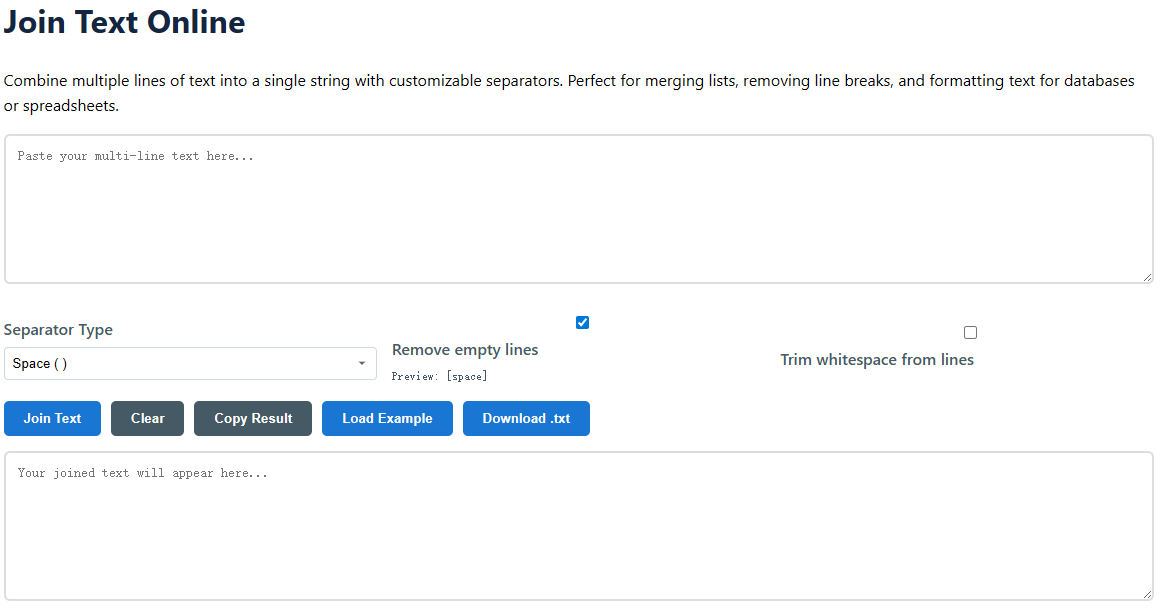
The logical flow of input, configuration and output control makes the tool both powerful and simple. These processes allow for efficient and reliable text merging, both when preparing a single list or batch-processing data.
Joining lines of text is an essential skill in digital workflows. This application is useful in many vocations and hobbies. It turns unorganised information into organised, useful data. Below are some fields where a text joiner proves to be an excellent utility.
The space separator unites the lines with a single space character in between, making a flowing sentence or phrase (e.g., "apple banana cherry"). Used for technical lists , no spacing . ( e . g . " apple , banana , cherry " ) . Joins them with a comma only . The default for readable English lists is "Comma + Space" (e.g., "apple, banana, cherry"). The decision depends on the format you want your final output in.
No. Tools to join text of this kind are often quite good and run fully in your web browser using JavaScript. This means that your text is processed locally on your computer and is never transferred to or stored on any external server. This ensures that your data remains completely private and secure, which is really crucial when dealing with sensitive lists or data.
Joining is performed after removing any unintended spaces or tabs from the start and end of each line. This is important for data integrity. For example, a line like " apple " becomes "apple". These errant spaces can cause problems in coding (breaking syntax), in databases (generating duplicate entries such as “apple” and “ apple”), or just seem unprofessional in final publications.
Yes. When you select the “Custom” separator option, you can use any string of characters as your joiner. This could be a simple " - " for a hyphenated list, a sophisticated sequence such as " |END| ", or even an HTML element such as "<br>" for web content. The custom field allows you to have complete control over the glue that ties your content together.
If you choose "New Line" (typically represented by \n), the lines of your input will be joined by a line break character. It may sound paradoxical, yet it is useful for reformatting text. For example, if you had a single paragraph with arbitrary breaks, you could paste it, use "New Line" to join (which effectively preserves the breaks) and then use the "Remove Empty Lines" option to clean it up, and you'd end up with a properly formatted block.
Yes, the inverse procedure is equally vital. If you want to split a single line of text into many lines, based on a comma, space or other delimiter, you would use a specific Text Splitter Tool. Together, these tools provide a complete set of capabilities to manipulate and convert between different text formats, allowing seamless data transformation workflows.