
Remove HTML Tags Online

Remove all HTML tags or selectively remove specific tags while keeping others

Select tags to remove:

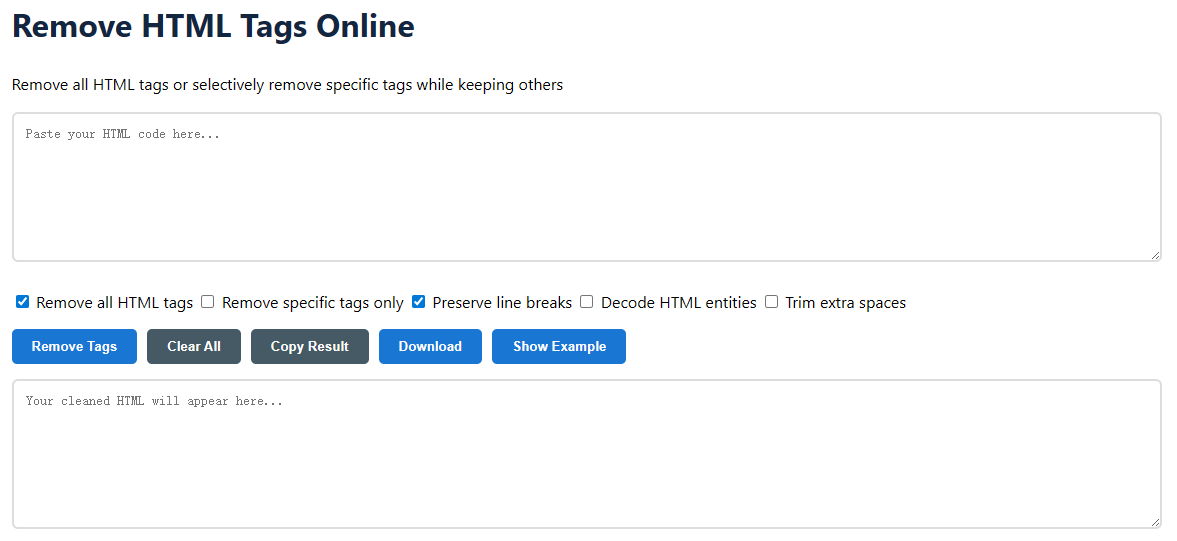
How to Use the HTML Tag Remover Tool

Our free online tool is designed to strip HTML tags from your code quickly and efficiently. Whether you need to extract plain text from a webpage, clean up content for a database, or prepare code for a different format, this tool provides a simple, no-download solution. The process is straightforward and requires no technical expertise.

  1. Paste Your HTML Code
  2. Configure Your Removal Options
    • Remove all HTML tags: Strips every tag, leaving only the raw text content.
    • Remove specific tags only: Enables selective removal using the tag buttons below.
  3. Fine-Tune the Output
    • Preserve line breaks: Maintains the structure of your text by keeping <br> tags and newlines.
    • Decode HTML entities: Converts characters like &amp; and &lt; back to & and <.
    • Trim extra spaces: Cleans up unnecessary whitespace for a neat result.
  4. Execute and Review
  5. Copy or Download the Result

For selective removal, simply click on the tag buttons (like <div>, <span>, <p>) you wish to strip away. You can also add custom tags not listed by typing them into the provided field. Once you click "Remove Tags," the cleaned text will instantly appear in the output box. Use the "Copy Result" or "Download" buttons to save your work.
What Are HTML Tags and Why Remove Them?

HTML (HyperText Markup Language) tags are the building blocks of web pages. They are instructions enclosed in angle brackets (like <p> or <a>) that tell a web browser how to structure and display content. While essential for creating rich, interactive web pages, these tags are often unnecessary and problematic when you need the raw text content for other purposes.

  • Content Migration: When moving text from a website to a plain text document, PDF, or a Content Management System (CMS) with a different formatting system, tags can cause errors and display issues.
  • Data Analysis & Processing: For tasks like text mining, sentiment analysis, or SEO auditing, clean text without HTML markup is required for accurate processing by algorithms and software.
  • Email Campaigns: Some email clients have strict rendering rules. Removing unnecessary or complex HTML can improve compatibility and deliverability.
  • Code Debugging: Isolating the textual content from the markup can help identify content-related issues or verify the text that will be read by screen readers.
  • Improving Readability: Pasting formatted web text into a simple notepad often results in a mess of tags. Cleaning it makes the text instantly readable.
  • Preventing Security Risks: Removing <script> and <style> tags from user-generated content is a basic security measure to prevent Cross-Site Scripting (XSS) attacks.
  • Creating Snippets & Previews: Generating clean meta descriptions, social media snippets, or article previews often requires plain text extracted from HTML.
  • Academic & Research Work: Researchers extracting quotes or data from web sources need the pure text for citations and analysis, free of formatting code.

Key Features of Our HTML Stripper

This tool goes beyond simple tag stripping. It is built with precision and user control in mind, offering a suite of features to handle virtually any HTML cleaning task you encounter.

  • Bulk & Selective Removal: Choose between wiping all tags for a complete clean slate or surgically removing only specific tags (like <span> or <a>) while preserving others for structure.
  • Intelligent Tag Selection: A comprehensive panel of common tags (div, p, img, script, headers, lists) allows for one-click selection. The custom tag field handles any tag, including proprietary or non-standard ones.
  • Formatting Preservation: The "Preserve line breaks" option intelligently maintains paragraph and line spacing, ensuring your extracted text doesn't become a single, unreadable block.
  • Entity Decoding: Converts HTML entities (e.g., &nbsp;, &copy;, &gt;) back to their standard characters, which is crucial for getting the actual intended text.
  • Whitespace Management: The trim function eliminates leading, trailing, and excessive spaces between words, delivering a polished final text.
  • Result Portability: Instantly copy the cleaned text to your clipboard or download it as a .txt file for offline use and archiving.

All processing happens securely in your browser. Your HTML code is never sent to our servers, guaranteeing complete privacy and speed for your data, no matter how sensitive.

Before and After: HTML Tag Removal Examples

Seeing the transformation makes the utility clear. Below is a comparison table showing how different types of HTML content are processed by the tool with various settings enabled.

Input HTMLOutput (Remove All Tags + Preserve Line Breaks)Output (Remove Specific: <a>, <strong> + Decode Entities)
<h1>Welcome</h1>
<p>Visit our <a href="#"><strong>homepage</strong></a>.</p>
<p>Price: &lt;$10&gt;</p>
Welcome
Visit our homepage.
Price: <$10>
<h1>Welcome</h1>
<p>Visit our homepage.</p>
<p>Price: <$10></p>

The first example shows a complete strip to plain text with logical line breaks. The second demonstrates selective removal: the link and bold formatting tags (<a> and <strong>) are gone, but the paragraph and header tags remain, and the HTML entity &lt; is decoded to "<". This granular control is ideal for partial cleanup.

Frequently Asked Questions (FAQ)

Is my data safe when using this tool?

Absolutely. This is a client-side tool, meaning all processing happens directly in your web browser. Your HTML code is never uploaded to any server. You can even use it offline after the initial page load without compromising your data's security.

What's the difference between "Remove all tags" and "Remove specific tags"?

"Remove all tags" is a blanket operation that strips every HTML tag, leaving only the raw text content. "Remove specific tags" gives you surgical control, allowing you to remove only certain tags (like all <div> and <span> tags) while keeping others (like <p> or <br>) to maintain some structure.

Why should I use the "Decode HTML entities" option?

HTML uses special codes called entities to display reserved characters (like <, >, &, "). For example, "&lt;" represents "<". If you don't decode them, your output text will contain these codes instead of the intended symbols. Enabling this option converts them back to their normal characters.

Can I remove tags that aren't listed in the buttons?

Yes. Use the "Enter custom tags" field. Type the tag names without angle brackets, separated by commas. For example, entering "blockquote, nav, footer" and clicking "Add Tags" will allow the tool to target and remove those specific tags from your code.

Does this tool handle JavaScript or CSS inside script/style tags?

Yes. When you select to remove <script> or <style> tags (either via "Remove all" or selectively), the entire content within those tags—including all JavaScript code or CSS rules—is completely removed from the final output, leaving only the visible page text.

Pro Tips for Effective HTML Cleaning

To get the most out of this tool and ensure flawless results for your projects, consider these advanced tips and best practices.

  • Use "Show Example": If you're unsure how to proceed, click the "Show Example" button to load a sample HTML snippet. You can then experiment with the different settings to see their effects in real-time.
  • Layer Your Cleaning: For complex HTML, sometimes a two-pass approach works best. First, remove all tags to get pure text. Then, paste the original HTML again and use selective removal for a more structured clean-up.
  • Check for Inline Styles: Remember that the tool removes tags, not inline CSS styles within a style attribute (e.g., <p style="color: red;">). The tag is removed, but the text remains. For a pure plain-text output, this is fine.
  • Combine with Formatting: After stripping tags, you can paste the clean text into a word processor or editor and use its native tools to apply consistent, safe formatting for your new destination.
  • Validate Input Source: If you're extracting HTML from a website's "View Source," ensure you're copying the relevant section. Using browser developer tools to inspect an element often provides a cleaner HTML snippet to work with.
  • Bookmark for Efficiency: Save this page to your bookmarks bar. It's a utility you'll likely need again, and having instant access saves time compared to searching for a solution.

By understanding these nuances, you can transform this simple tag remover into a powerful component of your content management and data processing workflow.