
Hex: #0F5C8C
RGB: 15, 92, 140
In the digital era, colours are not simply named, but rather specified by numerical codes. Two of the most basic and most used systems are Hexadecimal (Hex) and Red, Green, Blue (RGB). A Hex to RGB converter is a vital tool for web designers, developers, digital artists and anyone who deals with digital colour. It takes the compact, web-friendly Hex code and converts it to RGB values that graphics software and display hardware can understand. This conversion is important to know because it helps maintain colour consistency when you move your design between platforms and media. You want the bright blue you pick in your design program to look the same on a website or in a printed mockup.
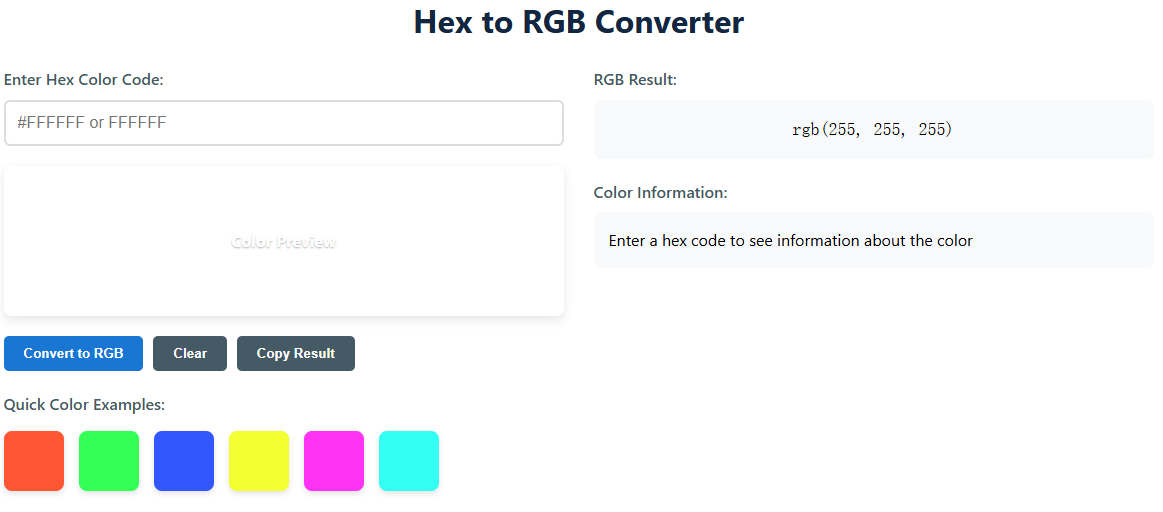
Our Hex to RGB converter is designed to be fast and straightforward. Whether you are a pro or a beginner, you can do exact conversions in seconds. The application gives the answer as a number, but it also gives you a live colour preview and more colour information for you to comprehend it better. Follow this simple guide to maximise its features and smoothly add accurate colours to your digital work.
0F5C8C) or include it (#0F5C8C). The tool accepts standard 6-digit codes either way.Colour conversion raises a number of technological issues. This FAQ covers the most common questions customers ask regarding Hex codes, the RGB model and how our converter works. Clear, succinct solutions to get you through your creative and technical endeavours, from comprehending the basics of the hexadecimal system to debugging faulty inputs.
Hex and RGB are pretty much two distinct ways of representing the same RGB colour information. Hex is a shorthand, hexadecimal (base 16) representation of the 3 RGB values. This makes it perfect for programming. Other models include CMYK (Cyan, Magenta, Yellow, Key/Black) for physical printing, and HSL (Hue, Saturation, Lightness), which is frequently regarded as more natural for colour correction. More particular, our tool bridges the gap between web-standard Hex and globally known RGB values.
A 3-digit Hex code (like `#F53`) is a shortcut. Each digit is repeated to form a 6-digit code. For example, `#F53` becomes `#FF5533`. Our converter is designed for regular 6-digit codes. If you have a 3-digit code, simply extend it by repeating each character before entering it into the program for a proper conversion.
This error occurs when the input is not in an acceptable Hex colour format. Some common reasons are: using characters outside the 0-9 and A-F range (like G,Z or %), entering a code with the wrong number of digits (like 5 or 8 digits) or inserting the hash symbol in the wrong place. Make sure your code is 6 hex characters (with optional leading `#`).
This conversion is important in web development and design for styling websites with CSS. In graphic design, it is used to copy colour palettes from web mockups into tools like Adobe Photoshop or Illustrator. Game developers use it to define colours in their engines, and digital artists use it to keep their tools consistent. Basically, this conversion will help any workflow that needs to translate colour from a web reference to a production environment.