
Keep Or Remove Lines Containing

Filter your text by keeping or removing lines that contain specific text or patterns
What is a Line Filter Tool?

How to Use the Line Filter: A Step-by-Step Guide

  1. Input Your Text
  2. Define Your Filter Criteria
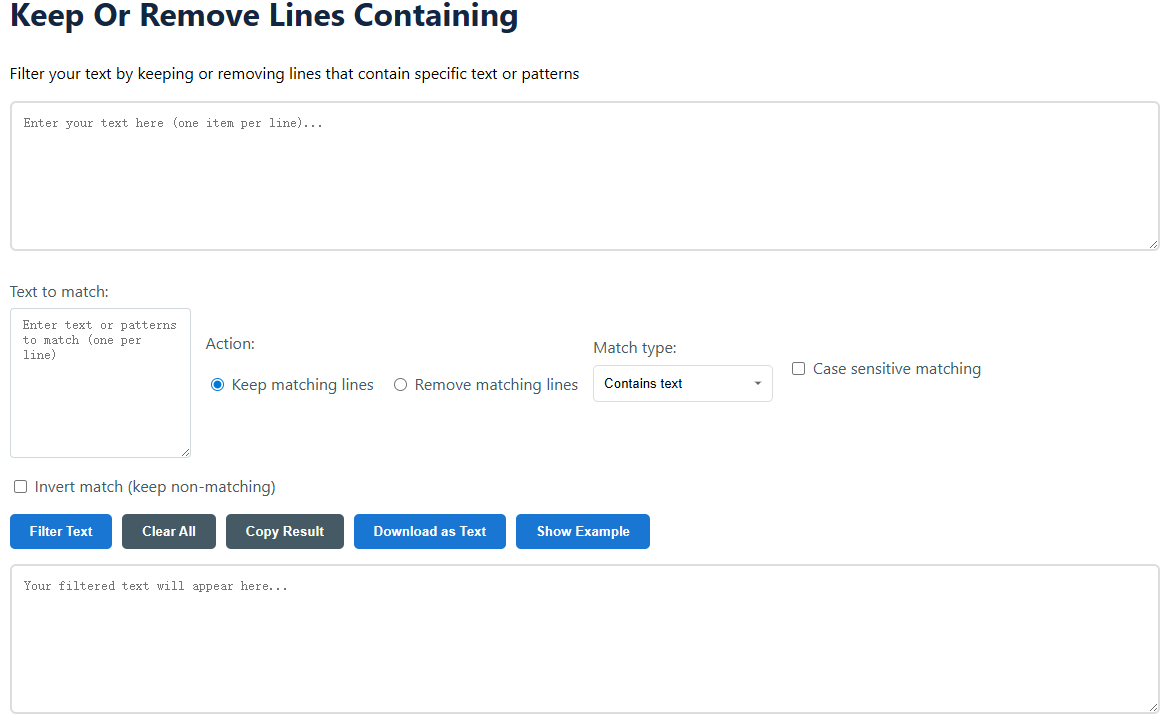
    • In the "Text to match" field, enter the specific words, phrases, or patterns you want to filter by. You can enter multiple terms, one per line.
    • Select your desired Action: "Keep matching lines" to isolate relevant data, or "Remove matching lines" to clean out unwanted entries.
  3. Configure Match Settings
  4. Choose a Match Type
    • Contains text: Matches lines where the specified text appears anywhere.
    • Exact match: Matches only lines that are identical to the filter text.
    • Starts with: Matches lines beginning with the filter text.
    • Ends with: Matches lines ending with the filter text.
    • Regular expression: Use powerful regex patterns for complex matching (e.g., ^Error.*\d{4}$).
  5. Apply Advanced Options
    • Case sensitive matching: Check this to distinguish between uppercase and lowercase letters.
    • Invert match: Check this to reverse the logic (e.g., keep lines that do NOT match your criteria).
  6. Execute the Filter
  7. Export Your Results

Practical Example: Filtering a Server Log

Original Log:
INFO: User login successful for alice
ERROR: Database connection failed at 14:30
INFO: File uploaded successfully
WARNING: High memory usage detected
ERROR: Authentication timeout for user bob

Goal: Extract only the error messages for analysis.

Setup: Enter "ERROR:" in the match field. Choose Action: Keep matching lines and Match type: Starts with. Click "Filter Text".

Result:
ERROR: Database connection failed at 14:30
ERROR: Authentication timeout for user bob

Key Features and Use Cases

  • Data Cleaning and Deduplication
  • Remove duplicate entries, blank lines, or placeholder text from mailing lists, product catalogs, or code files. Filter out test data or outdated entries from a master spreadsheet exported as text.
  • Log File and System Monitoring Analysis
  • System administrators can filter application or server logs for specific error codes, IP addresses, or time stamps. Isolate "WARNING" and "ERROR" lines from verbose logs to quickly diagnose system issues.
  • Content Moderation and List Management
  • Moderators can filter user-generated content for banned keywords or phrases. Manage email subscription lists by removing addresses from specific domains or keeping only those from a whitelist.
  • Programming and Code Review
  • Developers can filter console output, isolate lines containing "TODO" or "FIXME" comments, or extract specific function definitions from a codebase. Use regex to find complex patterns like variable declarations or API calls.
  • Academic and Research Data Processing
  • Researchers can filter survey responses, experimental data, or literature excerpts for specific keywords or phrases, enabling qualitative data analysis and thematic extraction from large text corpora.

Frequently Asked Questions (FAQ)

Does the tool process my data online? Is it secure?

All processing occurs directly within your web browser using JavaScript. Your text data is never sent to our servers, ensuring complete privacy and security. You can use this tool confidently with sensitive information like logs, lists, or code.

Can I filter using multiple different words or phrases at once?

Yes. Simply enter each word or phrase on a new line in the "Text to match" field. The tool will treat each line as a separate filter criterion. For example, entering "error" and "warning" on separate lines will match any line containing either term (based on your selected match type).

What is the "Invert match" option used for?

The "Invert match" option flips the logic of your filter. If you choose "Keep matching lines" and check "Invert match," the tool will instead keep all lines that do not match your criteria. This is useful for tasks like removing all lines except those containing a specific header or tag.