How to Use Diacritics Remover Tool
We created our online diacritics remover to be simple and efficient. Whether you are a writer, programmer or student, you can sanitize your text in seconds. The program runs straight in your browser, so your data is private and secure. Follow the steps below to convert your text or use the advanced options for additional control over the conversion process.
- Type Your Text
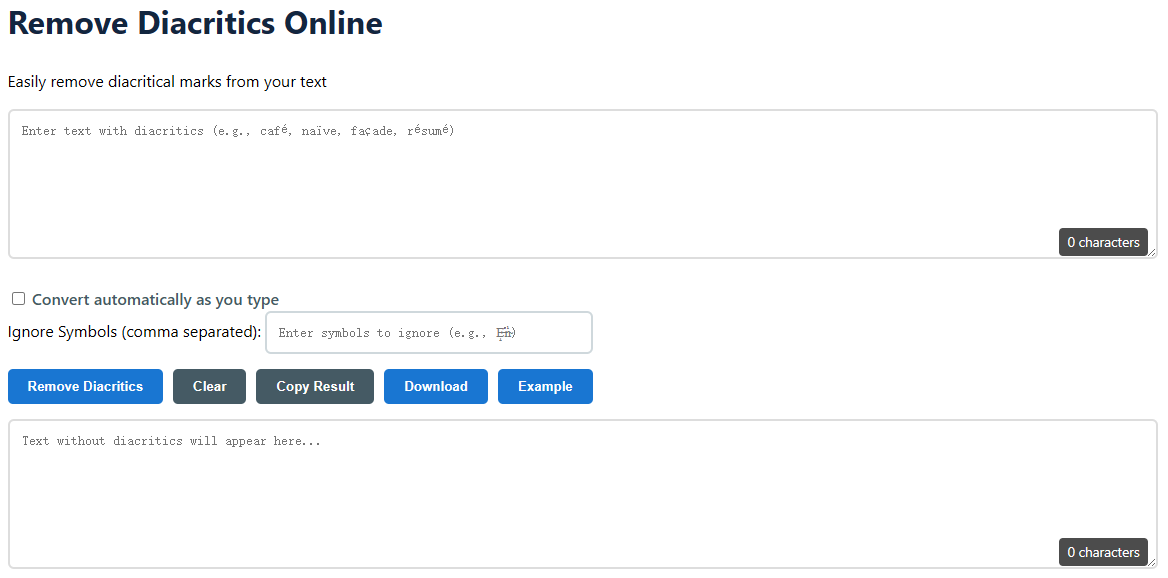
- Type or paste your text with diacritical markings into the upper text box.
- Some common examples are terms such as "café", "naïve", "façade", or "résumé".
- See the character counter update in real time as you type or paste.
- Set Options (Optional)
- To convert automatically and live, turn on "Convert automatically as you type".
- Specify complex combination characters you want to keep in the “Ignore Symbols” area in order to avoid them from being changed.
- Execute and Export
- Press the "Remove Diacritics" button to process your text. The cleaned result is shown immediately below in the output box.
- Copy the result using the toolbar or download as a .txt file. Or clear both fields and start anew.
How the Diacritics Removal Works
A basic interface hides a complex text normalization engine. The application uses Unicode normalization forms and character mapping to accurately take out diacritics while maintaining the base letter and the remainder of your text. This technique guarantees compatibility and readability on all digital platforms.
Step 1: Text Parsing and Normalization
The tool then checks the input string for any Unicode characters that are formed of a base character and one or more combining marks. It uses the Unicode Normalization Form D (NFD), which breaks characters down into their constituent components.
- The string "café" is broken down into 'c', 'a', 'f', 'e', ' ́' (combining acute accent).
- Characters are analyzed individually for diacritical associations.
- Look at the "Ignore Symbols" list to prevent changing any user-defined character sequences.
- The text is ready for the filtering stage.
Step 2: Diacritic Filtering & Mapping
This core step removes all identified combined diacritical markings. For letters that can not be simply removed (e.g., "ø" to "o"), the tool has a complete mapping table to transform the character into its closest Latin-alphabet equivalent.
- Acute accent (´): é, á, í → e, a, i
- Grave Accent (`): è, ù → e, u
- Circumflex (^): ê, â → e, a
- Umlaut/Diaeresis (¨): ü, ö → u, o
- Tilde (~): ñ, ã → n, a
- Cedilla (¸): ç → c
- Everything else non-combining (letters A-Z, numbers, standard punctuation) remains unchanged.
Step 3: Output Creation
The last step is to join the filtered characters back into a clean new string. The utility maintains correct formatting, including spaces, line breaks, and tabs.
- The processed character array is concatenated back into a cohesive string.
- Whitespace and original formatting are retained exactly.
- The result is presented and can be copied or downloaded.
- The number of characters in the output is estimated and shown for your convenience.
Applications and Use Cases in the Real World
Diacritics removal solves a wide number of practical challenges in digital communication, data processing and content development. This application is helpful for experts working in numerous disciplines, from technical compatibility to user experience.
- Programming and Development: Cleanly generate slugs, URLs and filenames. Ensure database entries are searchable and consistent, and avoid problems in systems that do not completely support Unicode.
- Data Analysis and Cleaning: Normalize text data from sources worldwide so that it may be accurately sorted, filtered, and analyzed in Excel, SQL databases, or Python pandas.
- Content Creation and SEO: Create web page slugs (URLs) that are English-alphabet friendly. Improve internal site search and prepare metadata for use on platforms with character set restrictions.
- Academic Writing and Publishing: Format references, bibliographies, or submissions to journals requiring plain ASCII text, or prepare text for legacy publishing systems.
- Global Communication: Allow straightforward communication in multilingual teams or with systems (like some email servers or legacy software) that may corrupt or misread special characters.
Conversion of a real world example
Input (Text with diacritic): The café was a coördinator for São Paulo's crème de la crème event, complete with a piñata and a soupçon of panaché, a surprise résumé that belied its naïf facade.
Output (Text sans Diacritics): The cafe was a coordinator for Sao Paulo's creme de la creme event, complete with a pinata and a soupcon of panache, a surprise resume that belied its naif facade.
Main Advantages of Using Our Instrument
By choosing our specialized diacritics remover over manual editing or basic text editors, you have clear advantages: saving time, improving accuracy, and keeping your data safe.
- 100% Free and Instant: No sign up, no subscriptions, no limits. Results in milliseconds. At no cost.
- Full Data Privacy: All processing occurs locally in your web browser. Your text is never transferred to our servers, assuring total privacy.
- High Accuracy and Reliability: It works with solid Unicode standards, so it can accurately handle a large assortment of characters and languages, removing the uncertainty from manual replacements.
- User-Centric Design: The tool is built to be accessible to users of all technical levels, with features like live conversion, one-click copy/download, and a clear example.
- Platform Independence: Use the tool on any device equipped with a modern web browser – desktop, laptop, tablet or smartphone – no software download needed.
Common Questions (FAQ)
Get quick answers to common questions about diacritics removal, how the tool works, and what it is used for. If you don’t find an answer to your query here, the example and tool interface are intuitive and self-explanatory.
About Diacritics and the Tool
What the tool does and the characters it impacts.
- What are diacritical marks? Diacritics are marks added to letters to change pronunciation or to differentiate between words (like the emphasis on “é” or the tilde on “ñ”).
- Does this tool alter the meaning of words? It just modifies visual spelling, deleting accents. The semantic meaning is in context. For example, “résumé” (a document) becomes “resume” (to continue), so carefully review output.
- What languages and alphabets are supported? Works best with Latin-based alphabets (English, French, Spanish, German, Vietnamese, etc.). It is not intended for use with non-Latin scripts like Cyrillic, Arabic or Chinese.
Features and How to Use the Tool?
Questions about what the tool provides and how it functions in reality.
- What is "Ignore Symbols?" This advanced feature allows you to paste certain complicated combinations of characters (graphemes) that you do NOT want the program to change. This will be skipped in processing by the utility.
- Are there any limitations on text length? No, there is no hard limit. The results depend on the RAM of your device, but the tool can process documents of tens of thousands of characters without any problem.
- Will the tool keep my original formatting? Yes. All spaces, line breaks, tabs, and paragraph breaks are kept as you entered them. The only thing deleted is the diacritics.
Technical and Security
Technical and security issues around data management.
- Is my text secure? Where is it being processed? Your text is entirely secure. All processing is done on your browser; JavaScript is required. We do not upload any data to any server or keep any data.
- Can I use the output for commercial purposes? Yes. You can use the output for any personal, academic or commercial purpose. The tool just offers a transformation service.
- What do I do if I find a character that is not transformed correctly? The tool is fairly precise, although the Unicode standard is so large. If you notice a problem, please use the field “Ignore Symbols” for this particular scenario and provide us with an example for a possible improvement.