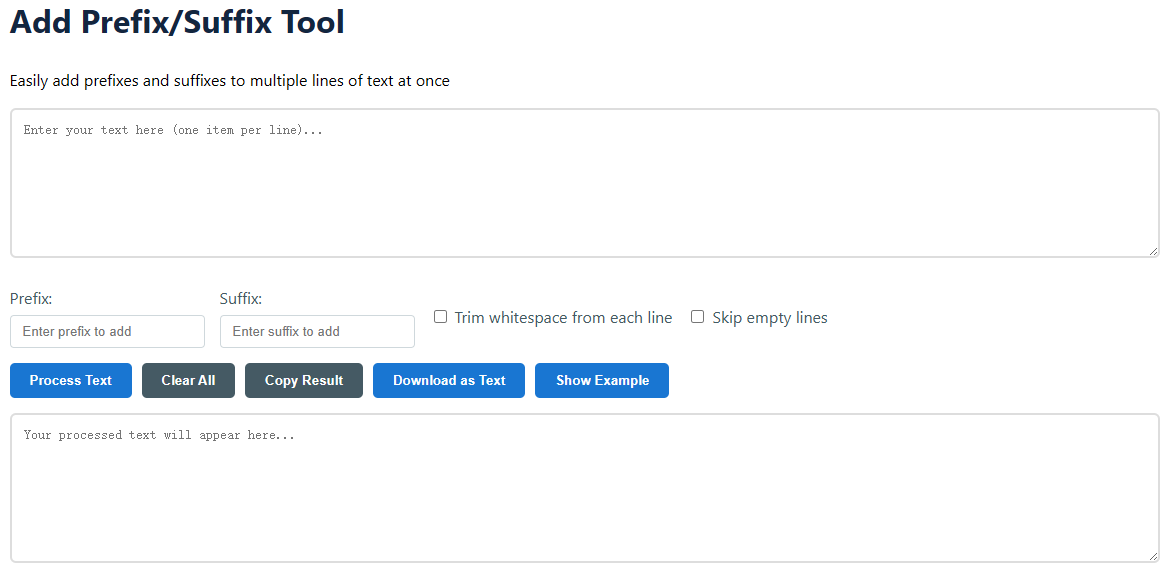
Add Prefix/Suffix Tool

Easily add prefixes and suffixes to multiple lines of text at once

What is a Prefix/Suffix Tool and Why Do You Need It?

  • Automates Repetitive Text Editing: Manually adding the same text to the beginning or end of hundreds of lines is tedious and error-prone. This tool automates the process in seconds, ensuring consistency and saving you hours of work.
  • Essential for Data Processing & Formatting: Whether you're preparing lists for programming, creating uniform file names, formatting data for import into a database, or generating bulk code snippets, adding prefixes and suffixes is a fundamental task.
  • Enhances Productivity Across Professions: From developers adding namespace declarations to code, marketers tagging URLs for campaigns, and researchers categorizing data points, to students formatting bibliographies, this utility is universally valuable.
  • Ensures Accuracy and Consistency: Eliminates the risk of human error, such as missing a line or adding an extra space. The tool applies the exact same modification to every selected line, guaranteeing a perfectly uniform output.
  • Offers Advanced Control: Beyond simple additions, features like trimming whitespace and skipping empty lines give you control over the cleanliness and structure of your final text, preparing it for use in other systems.

How to Use the Prefix/Suffix Tool: A Step-by-Step Guide

  1. Input Your Text
    Paste or type your list into the main text area. Ensure each item you want to modify is on a separate line. The tool processes line by line.
  2. Define Your Modifications
    • Prefix: Enter the text you want added to the beginning of every line (e.g., "https://", "Item: ", "var ").
    • Suffix: Enter the text you want added to the end of every line (e.g., ".com", ";", " - Processed").
  3. Adjust Processing Options (Optional)
    • Trim whitespace: Check this to remove any leading/trailing spaces from each line before adding the prefix/suffix. This is crucial for clean code or data.
    • Skip empty lines: Check this to ignore blank lines in your input, preventing the tool from adding prefixes/suffixes to nothing.
  4. Execute and Review
    Click the "Process Text" button. Your transformed text will instantly appear in the lower "Result" box. Review it for accuracy.
  5. Export Your Result
    Use the "Copy Result" button to paste it elsewhere, or "Download as Text" to save a .txt file. Use "Clear All" to reset for a new task.

Practical Example: Creating a List of HTML Image Tags

Input (List of filenames):
sunset.jpg
portrait.png
logo.svg
graphic.gif

Prefix: <img src="assets/
Suffix: " alt="image">

Output (Processed HTML):
<img src="assets/sunset.jpg" alt="image">
<img src="assets/portrait.png" alt="image">
<img src="assets/logo.svg" alt="image">
<img src="assets/graphic.gif" alt="image">

Real-World Applications and Use Cases

  • Software Development & Scripting: Quickly add command prefixes (sudo , git ), variable declarations ($, var ), or language-specific syntax (semicolons ;, commas ,) to lists of parameters or values.
  • Digital Marketing & Analytics: Generate UTM-tagged URLs in bulk by adding a campaign suffix (?utm_source=newsletter&utm_medium=email) to a list of base URLs. Create standardized social media hashtags or mentions.
  • Data Management & CSV Preparation: Format data for database import by adding SQL syntax (INSERT INTO table VALUES (' as prefix, '); as suffix). Add quotation marks or delimiters to raw data lists.
  • File and Directory Management: Rename batches of files conceptually by adding version numbers (_v2) or project codes. Create structured lists of file paths by adding a common directory prefix.
  • Academic Writing & Citation: Format bibliographic entries by adding consistent numbering ([1] ) or citation markers. Prepare lists of terms with a common definition or category prefix.
  • Content Creation & Blogging: Turn a list of keywords into meta descriptions by adding introductory/closing text. Create bulk internal links by wrapping page names in HTML anchor tags.
  • System Administration: Build configuration files or scripts by adding a standard header comment to each line or appending configuration parameters to a list of server names.

Frequently Asked Questions (FAQ)

Does the tool modify my original text?

No. The tool is non-destructive and works on a copy of your input. Your original text in the top box remains unchanged. The modified result appears in the separate output box below. You can safely experiment without losing your source data.

What happens if I only fill in a Prefix or only a Suffix?

The tool is flexible. You can use it to add only a prefix, only a suffix, or both simultaneously. If you leave one field empty, it simply won't add anything from that side. For example, adding only the suffix ".zip" will turn a list of filenames into a list of archive names.

What's the difference between "Trim whitespace" and "Skip empty lines"?

These are distinct cleanup functions. "Trim whitespace" removes spaces, tabs, or newline characters from the start and end of each line of text. A line like " data " becomes "data" before processing. "Skip empty lines" completely ignores lines that contain no characters at all (they are omitted from the output). You can use both options together for the cleanest possible result.