
Precisely remove unwanted spaces in the text
Original length: 0 chars
Trimmed length: 0 chars
Whitespace removed: 0 chars
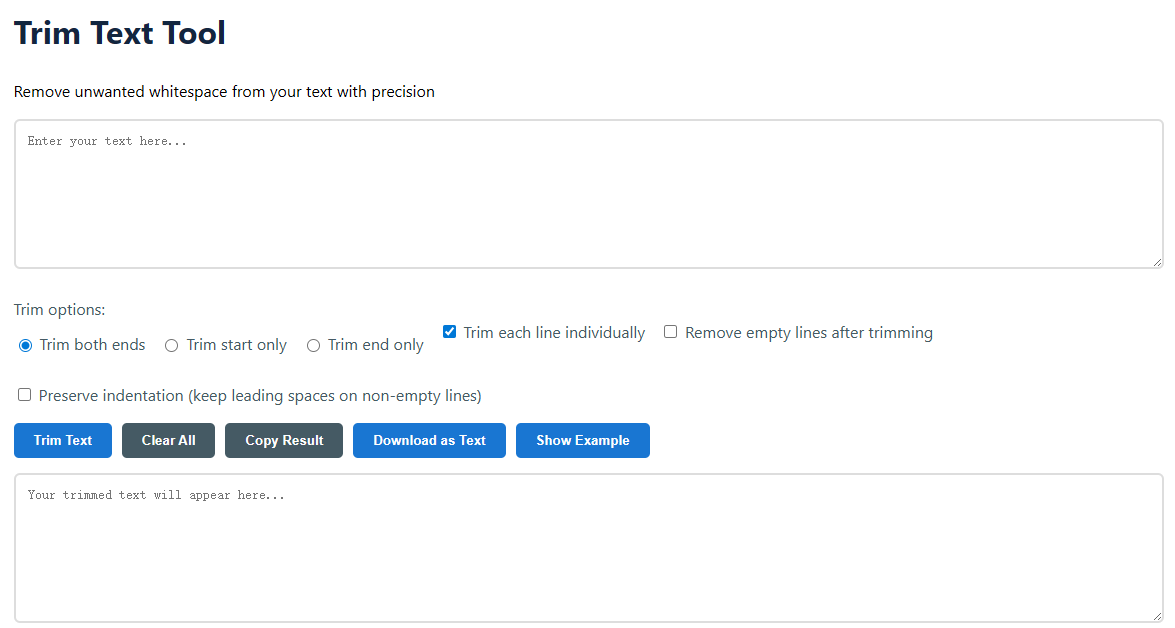
Trim both ends: Removes spaces, tabs and newlines from the very beginning and very end of the full block of text. This is the normal setting.Trim only the beginning: Removes whitespace from the beginning (left side) of the text only. Useful for cleaning up pasted content that often has leading indentation.Trim only the ends: Removes whitespace just from the end (right side). Great for repairing lines where spaces have been accidentally placed after punctuation.Trim each row individually: When this box is checked, the tool will apply your chosen trim type (both, start, or end) to each line, not just the outer block.Remove blank lines after trimming: When an empty line (zero characters) occurs after trimming, it will be eliminated from the output. This shortens lists or addresses.Preserve indentation (keep leading spaces on non-empty lines): This advanced option preserves leading spaces/tabs in lines that have other characters. It just strips the "pure" whitespace from empty lines or strips trailing/outer block whitespace as configured. Apple
Banana
Cherry
Problem: inconsistent leading spaces on the list and a trailing newline.
Choose Trim both ends with Trim each row individually checked to make it consistent.
 Apple
Banana
Cherry
Result: Every line is aligned correctly, and the additional whitespace at the end of the block is deleted, giving us a nice, consistent list.
Whitespace is any character that represents horizontal or vertical space in text, but does not correlate to a visible glyph. These characters are important for formatting, but can cause problems if they appear in the wrong location. Based on your settings, our tool detects and removes the following often-used whitespace characters:
We care about your privacy and data security. This Trim Text Tool operates completely in your computer browser, using JavaScript. The text you paste is not transferred to our servers, saved in a database, or tracked in any way. The processing happens on your device. You can verify it by running the tool offline or by inspecting the network behavior of your browser.
These are powerful alternatives for multi-line text. Trim each row individually applies the trim operation (start, end, or both) to each line individually. If you have this checked and trim "start" it will delete *all* leading spaces on every line. Preserve indentation (keep leading spaces on non-empty lines) changes this behavior: it will preserve the leading spaces/tabs on lines with other content (non-whitespace characters), only trimming whitespace on lines that are entirely empty, or from the outer bounds of the text block according to your main trim type.
Yes. This tool is useful for simple code formatting chores, like removing trailing whitespace from the ends of lines (a typical style guide requirement), cleaning up pasted code snippets that have undesired indentation, or preparing blocks of text for usage in string literals. For extensive code reworking, a dedicated IDE is advised, but this tool is just right for a quick clean-up of JSON, SQL queries, configuration files or script outputs.