
One-click search and extract all URLs from the text
Our URL Extractor is a robust, web-based software that can quickly extract and pull out all web addresses from any text block. If you’re a developer going through HTML, a marketing evaluating backlinks or a researcher assembling sources, this application takes a difficult manual task and turns it into one click. It is 100% free, no sign-up, processes your data safely in your browser without sending it to any server. Follow the simple steps below to turn jumbled text into a tidy, actionable list of URLs.
Remove duplicate URLs: Remove duplicate links for a clean list.HTTP/HTTPS URLs only: Regular web URLs only, no mailto: or ftp:.Decode URL encoding: Converts characters like %20 into spaces.Remove URL parameters: Strips query strings (?id=123) to get the base URL.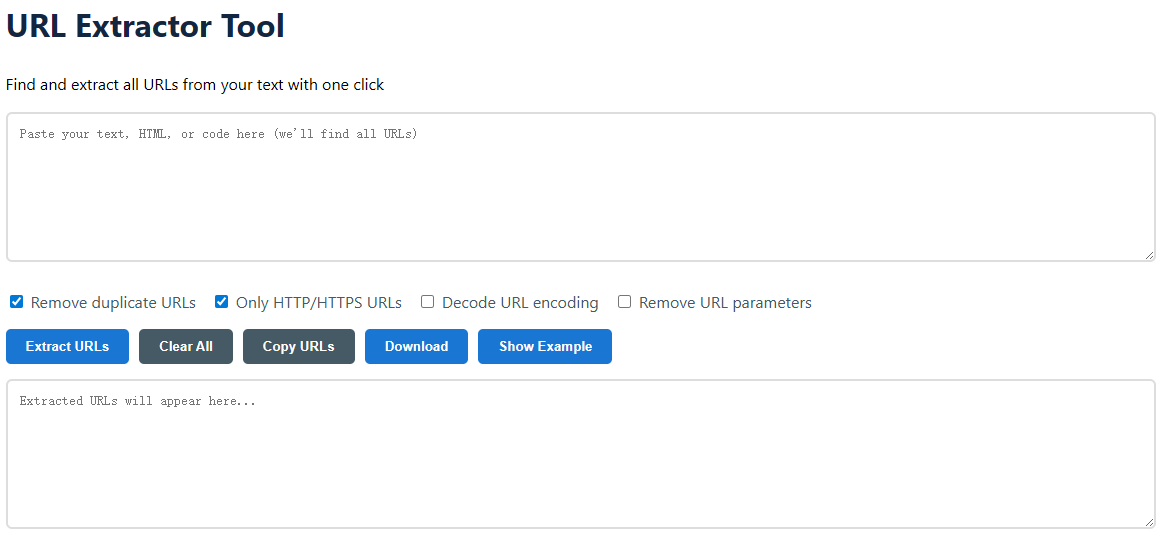
Manual link collection is inefficient and error-prone. This tool streamlines the process for a great variety of business and personal applications. URL extraction is an essential step in structuring and analysing data, whether it’s for SEO audits or academic study. These are the most common situations where our URL Extractor can be of tremendous value.
The program uses a complex regular expression (regex) pattern to find a large variety of Uniform Resource Locators. It is designed to identify not only valid, fully-qualified web addresses, but also frequent variants and encodings seen in the wild. Understanding what it can measure can help you interpret your data.
https://www.example.com/pagehttp://blog.example.co.uk/article?id=5https://example.com:8080/path/www.example.com (Protocol-relative)//cdn.example.net/asset.js (Scheme-relative)subdomain.example.org/path/file.pdfhttps://exa%6Dple.com/ (Obfuscated) -> https://example.com/http://example.com/file%20name.txt (URL encoded spaces)example.com/page#section (With fragment identifier)In addition to the basic extraction, the program provides a variety of smart processing options that help to improve your results. These capabilities will do typical data cleaning chores automatically, saving you time in post-processing. Each of these options is intended to handle a specific challenge when working with URLs derived from unstructured data.
Detects and removes duplicate URLs to give you a clean, unique list. This is important for analytics, link development, and sitemap generation, because counting the same link numerous times would bias the statistics.
If you set “Only HTTP/HTTPS URLs”, the tool will ignore non-web links like mailto:[email protected], ftp://server.com, and tel:+1234567890 and provide you with a neat list of web pages.
Converts percent-encoded characters to their regular form. For example, %20 is converted to a space and %2F is converted to a forward slash, so URLs are human-readable and consistent.
Strips query strings (anything after the ?) and fragment identifiers (after the #). This aids in canonicalization, page variant grouping and core page structure analysis.
You get to see the gadget in action, and it is obvious how powerful it is. This is a sample of mixed material with plain text, HTML and a faulty URL. The right column shows the clean, processed output after applying all available settings (duplicates deleted, just HTTP/HTTPS, decoded, arguments stripped)
| Input Text (HTML & Mixed Content) | Extracted & Cleaned URL List |
|---|---|
We have our blog at https://blog.example.com and our main site at http://www.example.com a link: Shop Now Don't forget http://EXAMPLE.COM/About-Us . Email us at [email protected]. Broken mention: htt://bad-url.com. Encoded link: https://ex%61mple.com/file%20name.doc | http://www.example.com/ https://blog.example.com/ https://example.com/shop http://example.com/About-Us https://example.com/file name.doc |
While many online tools do simple things, ours was designed with precision, user experience and data integrity in mind. We value your time and privacy and aim for a smooth workflow. Here are the primary advantages that make our tool better than manual solutions or other utilities.
Questions on how the tool works or what it can do? Here are answers to the most common questions we receive. If your question is not answered here, the interface and choices of the program are self-explanatory and intuitive when you use the tool.
Yes, it is. The entire extraction procedure runs locally in your web browser, using JavaScript. No text that you paste is uploaded to any server, recorded or stored. To prove this, you can load the page and disconnect your internet, and the tool will still work flawlessly.
Yes, but with one step, you will need to extract the text from the PDF or Word file first. Most of the time, you can accomplish this by selecting all text (Ctrl+A / Cmd+A) and copying (Ctrl+C / Cmd+C) from within the document viewer or editor. Copy the text above and paste it into our tool to get the URLs.
In a URL, special characters such as spaces, ampersands, or non-ASCII letters are often replaced by a percent sign (%) followed by hexadecimal codes. This option transforms the codes back to the original legible characters. For example, %20 becomes a space. %C3%A9 becomes "é".
The tool is made for accuracy, not guessing. It may miss URLs that are significantly broken (e.g., missing dots like "http://example"), obfuscated with purposeful typos, or written in plain text without a protocol (like "example.com") if they are part of a sentence without clear limits. All filters enabled: highest-quality results for regular web links.