How to Use the Email Extractor Tool
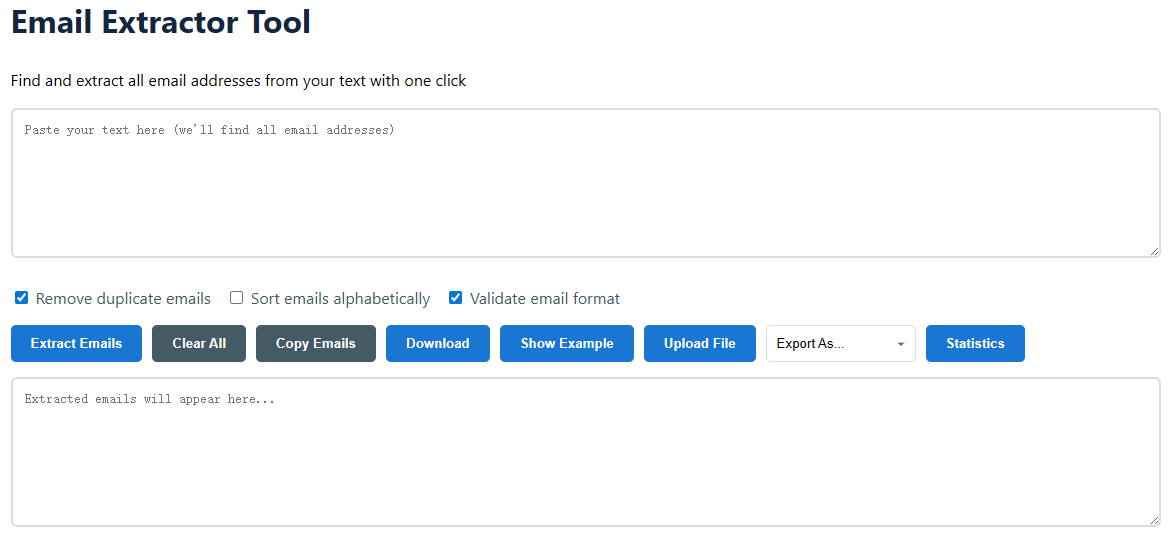
Our Email Extractor is simple yet powerful. If you are a marketer building a contact list, a developer cleaning up a dataset, or a researcher studying communications, this tool makes it easy to pull email addresses out of any text-based content. It’s a simple process, just enter your text, set your parameters and extract. The tool’s sophisticated processing engine works quietly behind the scenes to bring you clean, actionable results in real time. Then you may copy, download or export your list in a number of formats to use immediately in your projects or campaigns.
- Paste or Upload Your Text
- Configure Your Extraction Options
Remove Duplicate Emails: This ensures the final list contains only unique addresses, perfect for clean mailing lists.Sort Emails Alphabetically: Arranges the collected emails in alphabetical order, making it easier to navigate and handle them.Validate Email Format: Eliminates strings that don’t match standard email address formats, enhancing data quality.
- Click on "Extract Emails"
- Review and Control Your Results
- Export Your Clean List
- Click Copy to quickly paste into spreadsheet or email app.
- Click Download to download a basic text file to your device.
- In the Export As... dropdown, choose an option (CSV, JSON, etc.) for structured data you can use in other software.
Main Features & Advantages
This free web tool does more than just pattern matching. It is created with robust capabilities to handle real-world data and save you hours of manual effort, preserving the integrity of your extracted email lists. Each feature is built to produce professional results and be used in real-world applications, from working with huge documents to giving several output formats.
- Bulk Processing: Extract thousands of emails from big text files, documents or web page code in seconds.
- File Upload Support: Upload TXT, CSV, HTML, JSON, LOG and MD files directly. The tool scans the text content and automatically pulls out emails.
- Smart Deduplication: The “Remove Duplicates” tool works with case-insensitive matching to ensure no address is duplicated, which is very important for CRM imports and email campaigns.
- Format Validation: The validation check employs a complex regular expression to discard invalid patterns, filtering out typical typos and malformed texts.
- Export Options: Make your data fit the bill. Plain text, CSV for spreadsheets, JSON for apps or custom separators (commas, semicolons).
- Privacy-First Design: All processing is securely performed in your browser. Your data will never be transferred to our servers, ensuring complete confidentiality.
- Stats Panel: Click on the “Statistics” option to gain insights such as total emails found, number of unique emails, and most prevalent domain names in your list.
Uses
Email extractor is an all-in-one tool with many applications in many fields. It automates a laborious activity so professionals can focus on analysis, outreach and strategy. Below are some of the most typical and effective uses of the instrument in business and research settings.
- Digital Marketing & Lead Generation: Create contact lists from industry forum discussions, blog comments or publicly available speaker lists for targeted outreach initiatives.
- Academic Research: Collect author contact details from bibliographies, research paper PDFs (converted to text) or conference proceedings for research participation requests.
- Data Cleaning & Migration: Pull email addresses out of notes fields or combined "Name & Email" columns in CSV files to clean up messy customer databases or contact lists.
- Web Development & SEO: Parse website's source code or sitemap files to gather all "mailto:" links for auditing or contact page verification.
- Customer Support Analysis: Analyse support ticket records or chat transcripts to find common contacts and communication patterns.
- Legal eDiscovery: Help document review procedures by swiftly identifying all email correspondents within enormous amounts of text-based evidence.
How it Works: Extraction Algorithm
At its heart, the technology is a finely tuned algorithm that can find email addresses within complex text. Here is a simple comparison of the basic logic and the improved logic that our tool applies to handle edge cases and improve accuracy.
| Simple Pattern Matching | Our Advanced Extraction Logic |
|---|
Search for text matching:
"[email protected]" | 1. Tokenise the input string.
2. Match candidates using RFC 5322 conforming regex.
3. Filter candidates by format validation (if enabled).
4. Normalise case for deduplication (if enabled).
5. Sort (if enabled)
6. Export to the desired format. |
FAQs (Frequently Asked Questions)
Questions on the Email Extractor Tool or how it works with your data? Here are the answers to the most popular questions. This tool is designed to be effective and easy to use while emphasising your privacy and data protection.
- Security of my data? Where does it get processed?
- Yep. We take your privacy seriously. All extraction processing is done locally, within your web browser, using JavaScript. What you put into the text box or the file you upload is never sent over the internet to our servers or to any third party. Once the page loads the first time, the tool can be used offline.
- What is the difference between "extracting" and "validating" emails?
- Extraction discovers all strings that seem to be email addresses (e.g. `[email protected]`). Validation verifies whether those extracted strings conform to the correct syntax standards for an email address (e.g., correct placement of @, valid characters, domain structure). Enabling validation reduces false positives such as `[email protected]` or `@domain.com`.
- What types of files may I upload?
- The utility supports text-based files such as .txt, .csv, .html, .json, .log, and .md (markdown). For files like PDF or DOCX, please copy and paste the text content first, or convert the file to a supported format such as TXT.
- Is it possible to use this program to scrape emails from a website?
- Yes, but indirectly. No URL entry allowed. But you can see the page source code of the site (typically in your browser right click then click "View Page Source"). Then copy all that HTML code and paste it into the tool. It will effectively locate all emails, including those buried in `mailto:` links and scripts.