
Master Hexadecimal Calculations with Our Advanced Tool
Hex to Decimal Converter
Need to understand the decimal value of a hex number? Our dedicated converter instantly translates any hexadecimal string into its base-10 equivalent, perfect for debugging and manual verification.
Working with decimal numbers and need the hex format? This tool performs the reverse conversion, turning standard decimal integers into clean hexadecimal notation for programming and system logs.
Welcome to our comprehensive Hexadecimal Calculator, an essential utility for programmers, digital designers, computer science students, and IT professionals. Hexadecimal, or base-16, is a cornerstone numeral system in computing, used extensively for memory addressing, color codes in web design, and representing binary data in a human-readable format. This powerful tool goes beyond simple arithmetic, supporting a full suite of operations including addition, subtraction, multiplication, division, exponentiation, and crucially, bitwise operations like AND, OR, XOR, NOT, and bit shifts. It is engineered to handle up to 16-digit hex values, providing instant results in hexadecimal, decimal, and binary formats alongside a detailed step-by-step breakdown. Whether you're debugging low-level code, designing hardware logic, or studying number systems, this calculator streamlines complex conversions and calculations, saving time and reducing manual error.
How to Use the Hexadecimal Calculator: A Step-by-Step Guide
Input Your Hexadecimal Values and Choose an Operation
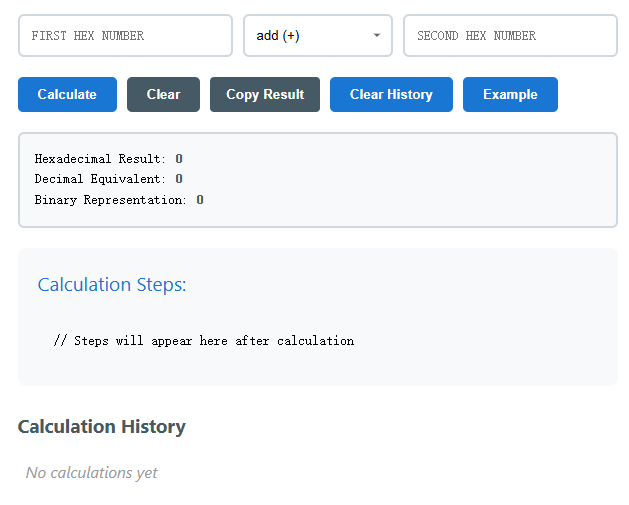
In the first input field labeled "First hex number," enter your initial hexadecimal value (e.g., A1F, 3B, or 10).
Use the dropdown menu to select your desired mathematical or bitwise operation (add, subtract, multiply, etc.).
For binary operations (like addition or AND), enter the second hexadecimal value in the "Second hex number" field.
Understand the Available Operations
add (+): Performs standard hexadecimal addition.
sub (-): Subtracts the second hex number from the first.
mult (×): Multiplies the two hex numbers.
div (÷): Divides the first hex number by the second (integer division).
exp (^): Raises the first hex number to the power of the second.
and (&): Performs a bitwise AND operation on the two numbers.
or (|): Performs a bitwise OR operation.
not (~): Performs a bitwise NOT (inversion) on the first number only.
xor (^): Performs a bitwise Exclusive OR (XOR) operation.
left shift (<<): Shifts the bits of the first number left by the second number's value.
right shift (>>): Shifts the bits of the first number right by the second number's value.
Execute and Review the Calculation
Click the green "Calculate" button to process your inputs.
Instantly view the Hexadecimal Result, its Decimal Equivalent, and its full Binary Representation.
Examine the detailed "Calculation Steps" section below to understand the precise logic applied.
Utilize Advanced Tool Features
Use the "Copy Result" button to quickly copy the hex result to your clipboard for pasting into code or documents.
The "Clear" button resets all input fields, while "Clear History" removes past calculations from the log.
Click "Example" to load a sample calculation and see the tool in action immediately.
Core Features and Practical Applications
Multi-Format Results
Get instant conversions between hexadecimal, decimal, and binary outputs.
Eliminate the need for separate conversion tools, streamlining your workflow.
View binary representations to understand the underlying bit patterns.
Comprehensive Operation Set
Perform both standard arithmetic and low-level bitwise logic operations.
Handle complex calculations like exponentiation and bit shifting with ease.
Unary operations like bitwise NOT are fully supported for single inputs.
Educational Transparency
Step-by-step breakdowns demystify each calculation's logic.
Learn hexadecimal arithmetic and bitwise manipulation interactively.
Calculation History allows you to review and compare past operations.
User-Centric Design
Input validation ensures only valid hex digits (0-9, A-F) are processed.
One-click copying and example loading enhance usability.
Clean, intuitive interface designed for both beginners and experts.
Where is a Hexadecimal Calculator Used?
Software Development & Debugging: Programmers use it to calculate memory addresses, work with hex color codes, manipulate flag values, and debug low-level code where data is often represented in hex.
Computer Science Education: An indispensable tool for students learning about number systems, computer architecture, assembly language, and digital logic design.
Network Engineering & Cybersecurity: Essential for analyzing packet headers, calculating subnet masks, understanding MAC addresses, and working with cryptographic keys often represented in hex.
Embedded Systems & Hardware Design: Engineers use it to configure hardware registers, set device memory maps, and perform direct bit manipulation on microcontrollers and FPGAs.
Digital Forensics & Reverse Engineering: Professionals analyze hex dumps of memory or storage, requiring calculations to understand offsets, checksums, and data structures.
This calculator is more than a simple converter; it's a bridge between human-readable numbers and the binary language of machines. By integrating arithmetic, logic, and instant multi-base conversion, it addresses a fundamental need in technical fields. The detailed steps and history log promote understanding and accuracy, making it suitable for verifying manual calculations or exploring new concepts. Its design prioritizes clarity and efficiency, ensuring that whether you're performing a quick check or a complex bitwise analysis, you have a reliable and powerful tool at your fingertips. Embrace the efficiency of automated hex calculation and enhance your technical projects today.