
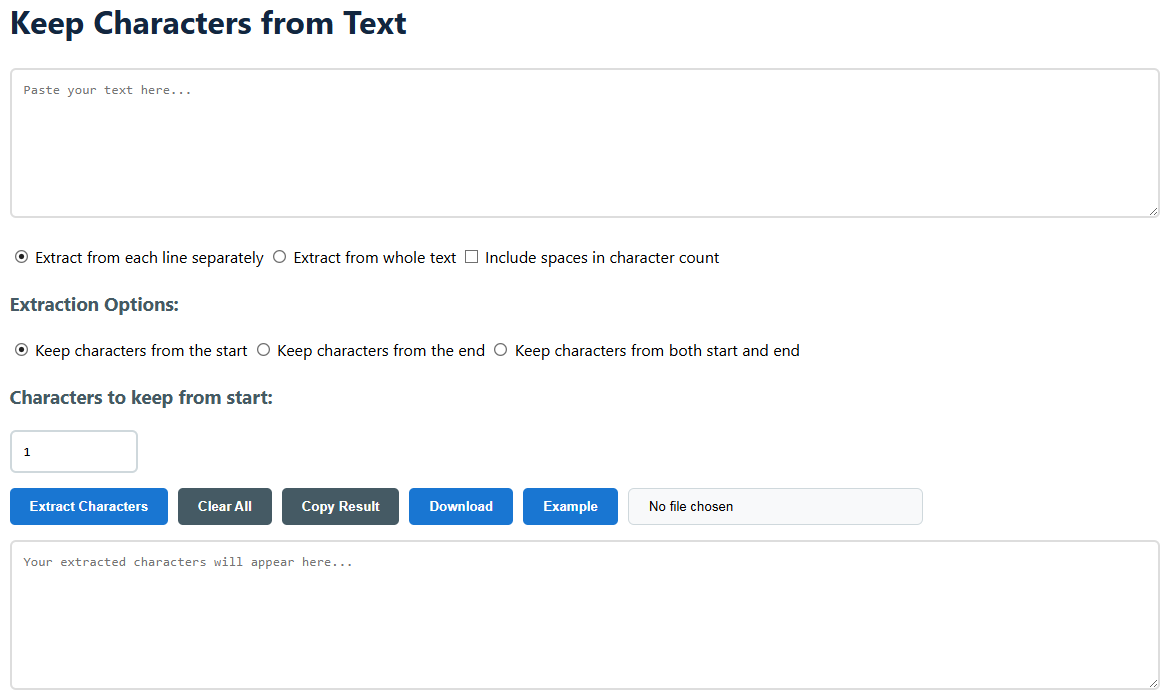
Enter a list of phrases to get their initials.
Alpha Beta Gamma Delta
Output after keeping 1 character from the start of each line.
P B G D
Copy your list of filenames to find the extensions.
document.pdf image.jpeg archive.zip script.js
Output after keeping 3 characters from the end of each line (Extract from each line on).
pdf peg zip .js
This application is particularly useful for data analysts, programmers, authors and administrators who have to reformat or extract certain parts of text data on a regular basis. Besides trivial examples, it can be applied to parsing log files (retaining timestamp prefixes), shortening URLs (retaining domain IDs), cleaning datasets (retaining key codes from strings) or preparing text for systems with stringent character restrictions (truncating intelligently from either end). It can be processed line by line or as a single block. This makes it versatile for both structured lists and prose. It automates a difficult manual search and delete procedure, saving a lot of time and human error. It also ensures consistent results over thousands of lines of text in seconds.
The theory behind it is simple to understand. If you chose “Extract from each line separately”, the tool will split your input at newline characters and apply your selected rule (start, end, or both) to each of the resulting segments separately. The “Include spaces” option changes the character definition in a fundamental way: When checked, a space counts as one. The "from both" function is not a combination, but an extraction: it takes some number of characters from the very beginning, and some number from the very end, and concatenates. It doesn’t eliminate the middle. It selectively preserves the two ends. That precision makes it excellent for things like looking at country codes and checking digits of long identification numbers without the middle bulk.