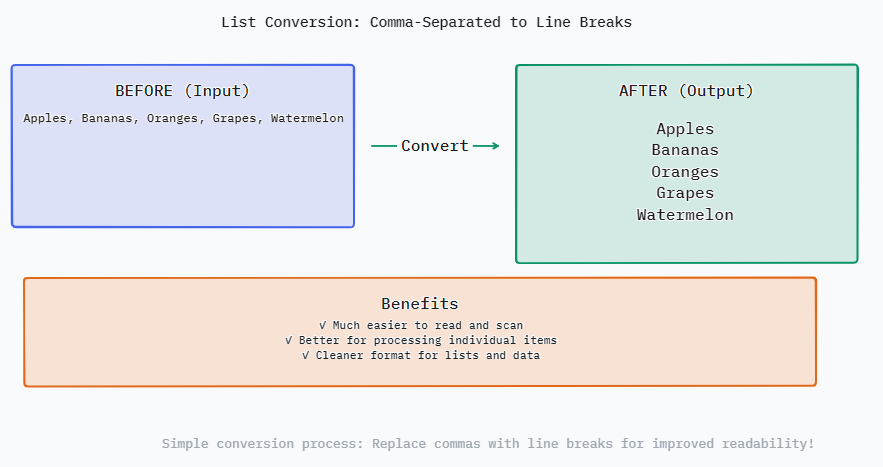
The converter works via a rigorous computational procedure for accuracy and efficiency. When you hit “Convert,” the tool first reads your raw input string. Then it “splits” it using the comma character (,). This action splits the single block of text into an array of distinct substrings. The optional step “Trim spaces” iterates over this array, deleting any whitespace characters from the start and end of each substring. Lastly, the “Remove empty lines” filter iterates across the array and removes any elements that are empty strings. The processed array is then rebuilt, combining each item with a new line character (`\n` or `\r\n`, depending on your operating system), which is what provides the visual line break. All of this happens in milliseconds, giving you a neatly structured list.
It solves a frequent, recurring challenge across numerous digital tasks. Transforming comma-separated values into line-separated lists is a crucial task in data prep, content organization, and workflow automation. It fills the gap between systems that export data in a compressed format and applications that demand list-based input. It saves time spent on manual reformatting, making professionals and students available for analysis and content creation—not tiresome editing.
Here are some typical queries and expert recommendations to help you get the most out of the tool and avoid common mistakes. Knowing how the tool deals with edge circumstances will help you get the outcome you want, whether you are working with basic lists or complex, nested data strings.
Input (Comma-Separated): A messy, raw list as it might be copied from a variety of sources.
Project Alpha Active In Planning,Completed, On Hold Completed
Output (Line Separated): The same data after conversion with “Trim spaces” and “Remove empty lines” checked.
**Project Alpha** Active In Planning
Completed
On Hold
Completed
Analysis: Notice how the conversion cleansed the data. Trimmed superfluous spaces surrounding " Active " and " On Hold ". The successive commas form an empty entry ", ,". That entry was completely deleted. The outcome is a nice, tidy vertical list with six different project status entries clearly displayed. This format is ready to be used as a status report, dashboard, or to be pasted into a table column. It clears visual clutter and makes duplicate entries ("Completed") obvious at a glance, which would have been missed in the comma-separated text.