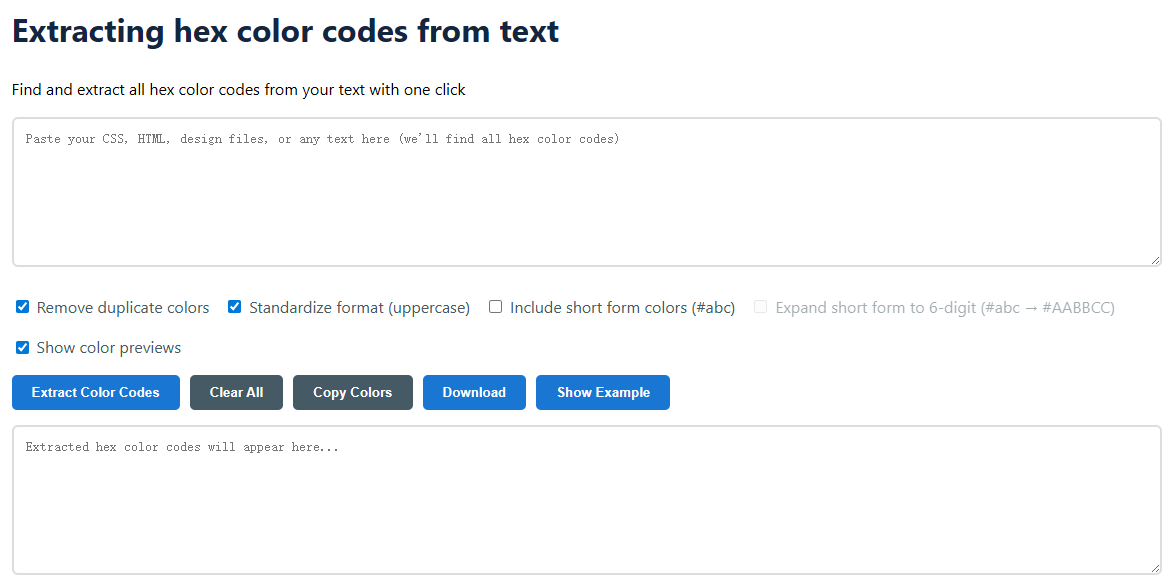
Find and extract all hex color codes from your text with one click
Our free online tool instantly scans your text, code, or documents to find every hex color code. Whether you're auditing a website's CSS, analyzing a design file, or cleaning up a document, this tool automates the tedious process of manual searching. Simply paste your content, customize the extraction with our options, and get a clean, organized list of colors in seconds.
Remove duplicate colors: Outputs only unique hex values.Standardize format (uppercase): Converts all codes to a consistent uppercase format (e.g., #FF5733).Include short form colors (#abc): Enables detection of 3-digit shorthand codes.Show color previews: Displays a visual swatch next to each extracted code.
Hex color codes are embedded in a wide variety of digital files and text formats. Knowing where to look helps you audit, migrate, or analyze color schemes efficiently. Here are the most common sources our tool is designed to parse.
A hex color code is a hexadecimal (base-16) representation of RGB (Red, Green, Blue) values. Our tool intelligently identifies the two standard formats. The table below illustrates the difference between the common 6-digit and shorthand 3-digit formats.
| 6-Digit Hex Code (Long Form) | 3-Digit Hex Code (Short Form) |
|---|---|
#RRGGBB Example: #FF9900 Red: FF (255) Green: 99 (153) Blue: 00 (0) | #RGB Example: #F90 Red: F (15) -> FF (255) Green: 9 (9) -> 99 (153) Blue: 0 (0) -> 00 (0) |
Note: The 3-digit shorthand is a condensed version where each digit is duplicated. #F90 is identical to #FF9900. Our tool's "Include short form colors" option controls whether to detect these abbreviated codes.
Behind the simple interface is a robust text-parsing algorithm designed for accuracy and speed. It uses a specific pattern-matching logic to ensure no color code is missed while avoiding false positives.
The core process involves scanning the input text for sequences that match the hex color code pattern: a hash symbol (#) followed by either 6 or 3 valid hexadecimal characters (0-9, A-F, a-f). The algorithm is case-insensitive by default but can standardize output to uppercase. It intelligently handles edge cases, such as codes within longer strings or URLs, to provide a clean, focused result.
This method is far more reliable than manual visual scanning, especially in large files where colors can be defined hundreds of times.
Manually searching for `#` in a code editor is error-prone and time-consuming. You might miss variations, struggle with duplicates, or waste time copying each value individually. Our tool solves this by providing a complete, actionable color palette from any source in one action.
This tool is indispensable for developers, designers, content creators, and digital marketers. It streamlines workflows that involve color analysis, migration, and consistency checks.
Speed up development and refactoring tasks with instant color audits.
Bridge the gap between design and development by analyzing color usage.
Extracting colors is the first step; managing them effectively is key to a maintainable project. Here are best practices to follow after using our extraction tool.
Once you have your list of colors, take these steps to create order from chaos.
Integrate your cleaned-up color data back into your project workflow.
By combining our extraction tool with these management practices, you ensure color consistency across all platforms and significantly reduce design debt.
Find quick answers to common questions about hex color codes and the functionality of our extraction tool.
A hex color code is a six-digit or three-digit combination of numbers (0-9) and letters (A-F) preceded by a hash (#), used in HTML, CSS, and design software to specify colors. It represents the red, green, and blue (RGB) components of a color.
No, this tool is specifically designed to extract hexadecimal color codes only. For extracting RGB, HSL, or named colors, you would need a different specialized tool.
Absolutely. All processing happens directly in your web browser (client-side). No text you paste is sent to or stored on our servers, ensuring complete privacy and security for your code and documents.
By default, the "Include short form colors (#abc)" option is unchecked to keep results focused on the more common 6-digit format. Simply check this box before extracting to include all valid 3-digit shorthand codes in your results.