
Convert tabs to spaces using custom settings
A Tabs to Spaces Converter is a tool that is vital for developers, authors and data professionals. It converts tab characters (represented as '\t') into the corresponding number of space characters. This procedure is called tab expansion and is necessary to maintain the formatting of code and text constant when displayed in multiple editors, platforms and displays. Tabs provide a single - character means of indenting, but their visual width is not consistent and may vary from program to application. This results in misaligned code blocks and jumbled text layouts. Tabs to spaces is one of the foundations of clean, legible, and portable source code. It imposes a stable, predictable indentation structure. This application makes the conversion for you with customisable options to choose how many spaces equal a tab stop.
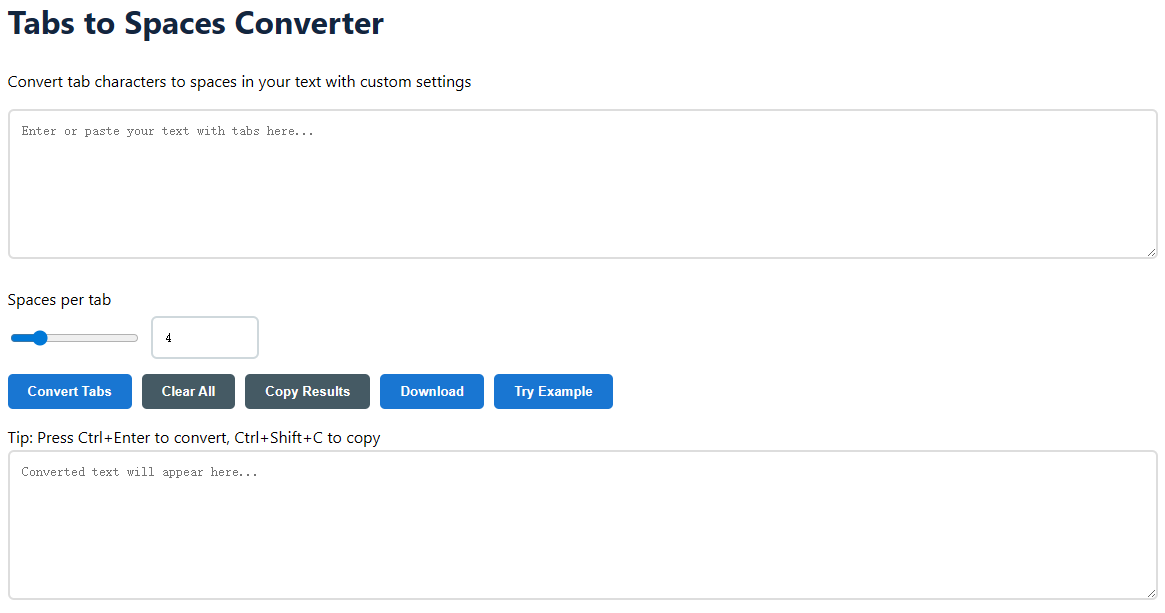
Our converter is optimised for the highest efficiency and convenience. Follow this simple step-by-step guide and change your text within seconds. Whether you're cleaning up a single script or batch-processing several files, the easy interface provides fast visual feedback and extensive choices to customise the result to your exact needs.
In the world of software development, there is the age-old dispute about tabs vs spaces. Knowing the technical guts of each helps you understand the reason for conversion. A tab character is a single control character (ASCII 9) that tells the editor to move the cursor to the next 'tab stop'. That advance's visual range can be configured. A space character (ASCII 32) is a fixed-width glyph. Our converter makes a precise algorithmic substitution. It scans the input string and replaces every '\t' with *n* spaces, where *n* is the number you choose. All other characters remain precisely as they were.
You have full control over the indentation by using spaces. It makes sure your code looks the way you want it to on GitHub, in code reviews, in various IDEs and printed. Indeed, several major style guides (e.g., PEP 8 for Python, or the Google style guidelines) explicitly encourage using spaces for indentation to prevent the visual disparities induced by different tab-stop settings.
Where to put this is decided by the rules of the programming language you are using or the project you are working on. Default is 4 spaces for Python per PEP 8. 2 spaces are prevalent in web programming (HTML/JS/CSS). Some older C or Makefile codebases may utilise 8. Always review the style guide of the existing project. The exact quantity is less significant than consistency within a single file and across a project.
Yes. The tool reads the input linearly, and for every tab character it detects, it replaces it with the number of spaces given. So if a line starts with 2 spaces and a tab set to 4 spaces, the outcome will be 6 spaces. This is important for conversion, but it illustrates why mixed indentation is often frowned upon: it can be confusing.
No. For all major programming languages, spaces and tabs are semantically identical whitespace for indentation. The conversion merely affects the way the code looks; it does not impact the logic or functioning of the code. The interpreter or compiler will treat them in the same manner. It’s a safe, non-destructive way to execute code.
This converter is useful for many professionals and hobbyists working with structured text. It's good for a lot more than programming, in any field where accurate text alignment is necessary. It solves a common, yet frustrating formatting problem with a quick, reliable and adjustable solution.
Here are some advanced insights and integration ideas to exploit this technology effectively in a professional workflow. Beyond conversion, these methods ensure code quality and team cohesion, transforming a basic tool into a cornerstone of your development standards.
Use linters and formatters such as ESLint (JavaScript), Black (Python) or Prettier (multi-language) as part of your project. Set them to highlight or auto-convert tabs to spaces. Integrate these tools in your CI/CD pipeline to fail commits with tab characters. This converter is great for one-off changes, but automation assures uniformity over time.
This utility is intended for a one-way conversion of tabs to spaces. The inverse process (tabs to spaces) is more complicated and unclear, since it is not clear how many spaces comprise one tab group. There are dedicated "Spaces to Tabs" converters for that.
Some types of code demonstrate the use of tabs to indent the beginning of a line and spaces to align inside a line. Our tool considers each tab identically. To execute a “smart” replacement technique, more powerful editor plugins or scripts are required. This program gives you the basic, trustworthy conversion that such tactics can be built on.
The program is client-side and highly efficient. It handles enormous documents (hundred thousands of lines) without a problem. The sole performance constraint is the memory of your browser. For consistently handling large files (e.g., multi-gigabyte logs), a specialised command-line script may be more suited, but for all normal source code and text files, this converter is more than sufficient.
Choosing this particular online Tabs to Spaces Converter has several advantages over editing manually or relying on the built-in editor tools. With the security, ease, and precision of the user being the main considerations, it provides a frictionless experience that is perfectly integrated into any digital process.