Using the Octal-to-Hex Converter
Convert numbers from the octal (base-8) number system quickly, accurately, and for free with this online tool into the hexadecimal (base-16) number system. It is aimed at programmers, students, and digital electronics engineers and automates a process that is tedious and error-prone when done manually. Enter your octal number and the converter will immediately provide you with the correct hexadecimal equivalent, with options to format the result as desired. It is a user-friendly interface accessible from any device with a web browser, without requiring installation or registration.
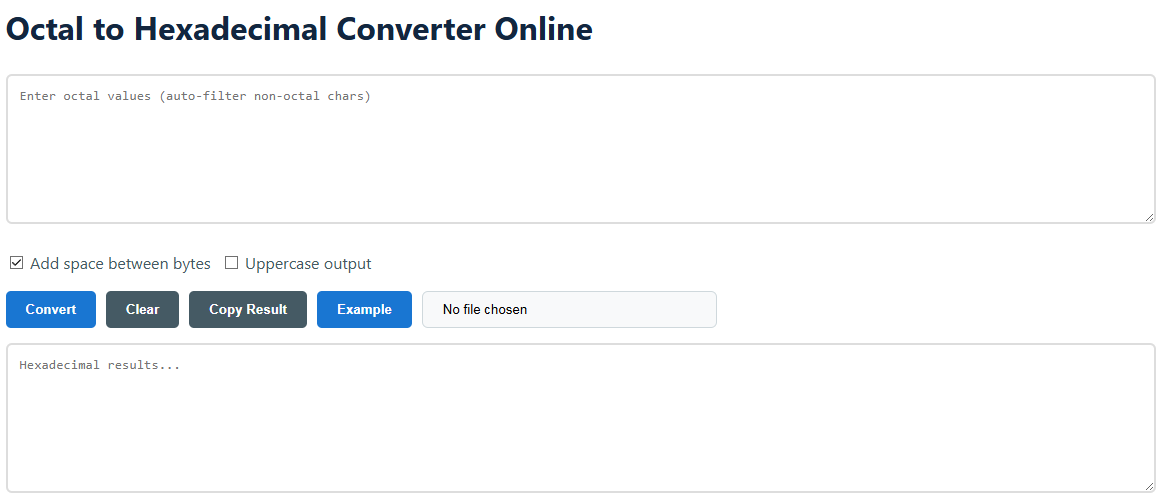
- Enter your octal number
- Enter octal values in the text area "Enter octal values". Octal numbers use the digits 0-7. The program does not allow octal numbers to contain non-octal digits such as 8, 9, or letters, and it automatically ignores them.
- Uploading a .txt file with octal data can also be done via the file upload button. For example:
152 377 040 or 152377040
- Configure output options
- Insert a space between the bytes: Wenn aktiviert, formatiert es die Hex-Ausgabe mit einem Leerzeichen nach jedem zwei Hex-Ziffern (z. B.,
6B A7 ). This is a typical way to represent byte values. - Uppercase edition: Enable this if you want hexadecimal digits A-F to be displayed in uppercase (e.g.,
6BA7) instead of lowercase letters (6ba7), as required by many programming language syntaxes.
- Execute and Manage Results
- Click on the Convert Button to process your input. The hexadecimal response appears immediately in the lower text area.
- Press the Copy result Button to copy the value copied to your clipboard, ready to paste into your code or document.
- Der Klar The button resets both input and output fields, while Example loads an example octal value to show how the converter works.
Knowledge of octal and hexadecimal systems
Octal- und Hexadezimalsysteme sind Stellenwertsysteme und von Natur aus kompakter zur Codierung binärer Daten als das Dezimalsystem, das wir im Alltag verwenden. Ihre Beliebtheit in der Informatik liegt in ihrer direkten Beziehung zum Binärsystem (Basis 2). Sie sind eine effektive Kurzschreibweise für Binärzahlen, da eine Oktalstelle genau drei Binärstellen (Bits) und eine Hexadezimalstelle vier Bits entspricht. Diese Umrechnung ist nicht nur eine akademische Übung in Mathematik, sondern eine praktische Notwendigkeit für die Programmierung auf niedriger Ebene, die Darstellung von Speicheradressen, die Fehlersuche in digitalen Systemen und die Handhabung von Dateiberechtigungen in Betriebssystemen wie Unix/Linux.
1. The Core Link: Binary as the Connector
The easiest way to perform the conversion is through binary numbers. This takes advantage of the ideal grouping of bits that both octal and hexadecimal numbers provide. To go directly from octal to hex, convert from octal to binary and then from binary to hex. The method is systematic and minimizes errors in calculation and can be used for both human calculations and algorithm implementation.
- Oktal zu Binär: Each octal digit is replaced by its 3-bit binary equivalent. For example, octal
7 ist binär 111. - Binary to hexadecimal: Teilen Sie die Binärziffern von rechts nach links in Gruppen von 4 auf. Ersetzen Sie dann jede 4-Bit-Gruppe durch die entsprechende Hexadezimalziffer.
2. Direkte Umrechnung Dezimal
Another (often more computational) method is to convert the octal number to its decimal value and then convert this decimal value to hexadecimal. The idea behind this method is simple, but involves more steps for larger numbers. This is done by recognizing the place value of each digit in the octal number, summing the contributions, and then sequentially dividing by 16 for the hexadecimal conversion.
Octal to Decimal: Take each digit and multiply it by 8n, where n is the position of the digit from the right, starting at 0. Add the results.Decimal to Hexadecimal: Divide the decimal value repeatedly by 16 and note the remainders. The hexadecimal value is read backwards from the series of remainders (10-15 become A-F). Although computers do not use this strategy, it is very useful for better understanding the mathematical basics of number systems.
3. Example of manual calculation
Let us convert the octal number 247 in hexadecimal using the binary bridge approach to demonstrate the reasoning that our technology automates.
- 28 = 0102
- 48 = 1002
- 78 = 1112
- Concatenate:
010100111 - Group the binary numbers from the right into 4-bit nibbles (pad on the left if necessary):
0000 1010 0111 - Convert each group:
0000 → 0, 1010 → A, 0111 → 7 - Result: Hexadecimal
0xA7 or A7 (dezimal 167)
Practical applications and examples
Die Oktal-zu-Hexadezimal-Konvertierung ist kein akademisches Relikt, sondern ein echtes Instrument in der modernen Technologie. Sie wird für alles verwendet, von der Wartung alter Systeme bis hin zur Spitzentechnologie-Entwicklung. Dieses Verständnis der Anwendungsfälle lässt einen nun die Bedeutung des Werkzeugs erkennen, nicht nur zum Konvertieren, sondern als ein Werkzeug, um reale technische Herausforderungen effektiv zu lösen.
Other important use cases
- Embedded Systems & Microcontroller Programming: Memory-mapped I/O registers and device control words are usually documented with addresses and values in hexadecimal. For developers working with older documentation or certain hardware manuals, these values may be in octal, and they may need to convert them on the fly.
- Digital circuit design & troubleshooting: When reading from a hardware debug port or assessing the state of a digital system with a logic analyzer, the data may be in a compact octal format. Switching to hexadecimal can help make patterns more understandable and easier to match with the outputs of a software debugger.
- Outdated software and assembly: Some older assembly languages or system documentation (e.g., PDP-8, PDP-11) often used octal numbers. Modern analyses or cross-development must convert these values to hexadecimal numbers, the current standard.
- Netzwerk- und Sicherheitsanalyse: Paketheader und einige Felder in veralteten Protokollen können in Oktal angegeben werden. Die Umwandlung in Hexadezimal erleichtert den Vergleich mit gängigen Protokollanalysatoren (z. B. Wireshark), die hauptsächlich hexadezimalbasiert sind.
- educational purpose: This will be useful for students taking courses in computer architecture, number theory, or programming fundamentals, as they can immediately check their hand conversions and verify their understanding of the relationship between base 8, base 2, and base 16.
- Data recovery and forensics: In some cases, raw data can be interpreted in multiple numeral systems during forensic analysis of hard disk sectors or memory images. An octal-to-hex converter is useful for quickly reinterpreting data blocks when the original assumption about the data format changes.
- Farbcodierungskonvertierung (weniger gebräuchlich): RGB color is common for hex values; some extremely old or specialized systems might have used octal triples to express color values. A conversion allows translation into current web-ready hex color codes like #RRGGBB.
Frequently Asked Questions
- Q: What happens if I enter 8 or 9?
A: It empties them automatically. Only the digits 0-7 can be used in the octal system. Your input is cleaned in real time. - Q: I have an extremely long octal number. Can I convert it?
A: Yes. The program can process a large amount of data, limited only by the capacity and capability of your browser. It is well suited to transform long data streams. - Q: Will the result for '0xA7' and 'A7' be different?
A: Same core hex value. The prefix 0x is a common notation in programming languages (C, Java, Python, and others) to represent a hexadecimal literal. Our tool displays the hex digits; you can add one 0x Prefix, if your workflow requires it. - Q: Wann sollte ich „Leerzeichen zwischen Bytes hinzufügen“ überprüfen?
A: This is intended to make raw data dumps easier to understand, such as machine code or memory dumps, where data is often examined byte by byte (two hexadecimal digits per byte). - Q: Does the tool support broken octal numbers?
A: No, this converter is for integer conversion. Converting fractions between number systems is a more complicated process and is not handled by this service. - Q: Are my data safe with this online converter?
A: Sure. All conversions are done locally in your web browser (client-side JavaScript). Your information is never sent to a server, so it remains completely private and secure.